
Autauga County Court Records After a Jail Arrest
Court records after a jail arrest in Autauga County build on the arrest and booking side of a criminal matter. The local custody record is handled by the Autauga County Sheriff's Office and the Autauga County Metro Jail at 136 North Court St. in Prattville. Alabama Code Section 36-22-8 requires the sheriff to keep a public jail record book for prisoners received into the county jail, including identifying description, charge, commitment, and release information. Sheriff Mark Harrell's office is the local starting point for custody questions, but the sheriff does not decide the final prosecution charge.
The court charge record begins or develops when a complaint, information, indictment, warrant, or other charging document is filed in the Alabama court system. The Autauga Circuit Clerk maintains court filings and division contacts, and the 19th Judicial Circuit District Attorney, C.J. Robinson, decides what formal charges to pursue in state criminal court. For roster and booking detail, use jail inmate records. For booking photos, use jail mugshots. For court charges after arrest, use Alacourt, the Circuit Clerk, and the court docket.
How to Find Autauga County Court Records After an Arrest
The statewide court search route is Alacourt / Just One Look, Alabama's trial-court public access portal. It is the better channel for case numbers, filed charges, docket entries, court dates, and disposition information. The sheriff's roster route can help identify a booking date or booking charge, but the formal court record is maintained through the court system, not the jail roster.
The Autauga Circuit Clerk page gives practical division contacts for follow-up when online access is incomplete. Circuit Criminal is listed at 358-6807 in Room 117, and District Criminal / Traffic is listed at 358-6802 in Room 117. The courthouse and clerk are at 134 North Court Street in Prattville, with main phone (334) 358-6800.
The Alacourt public access portal is shown in the state court access source captured for this build.
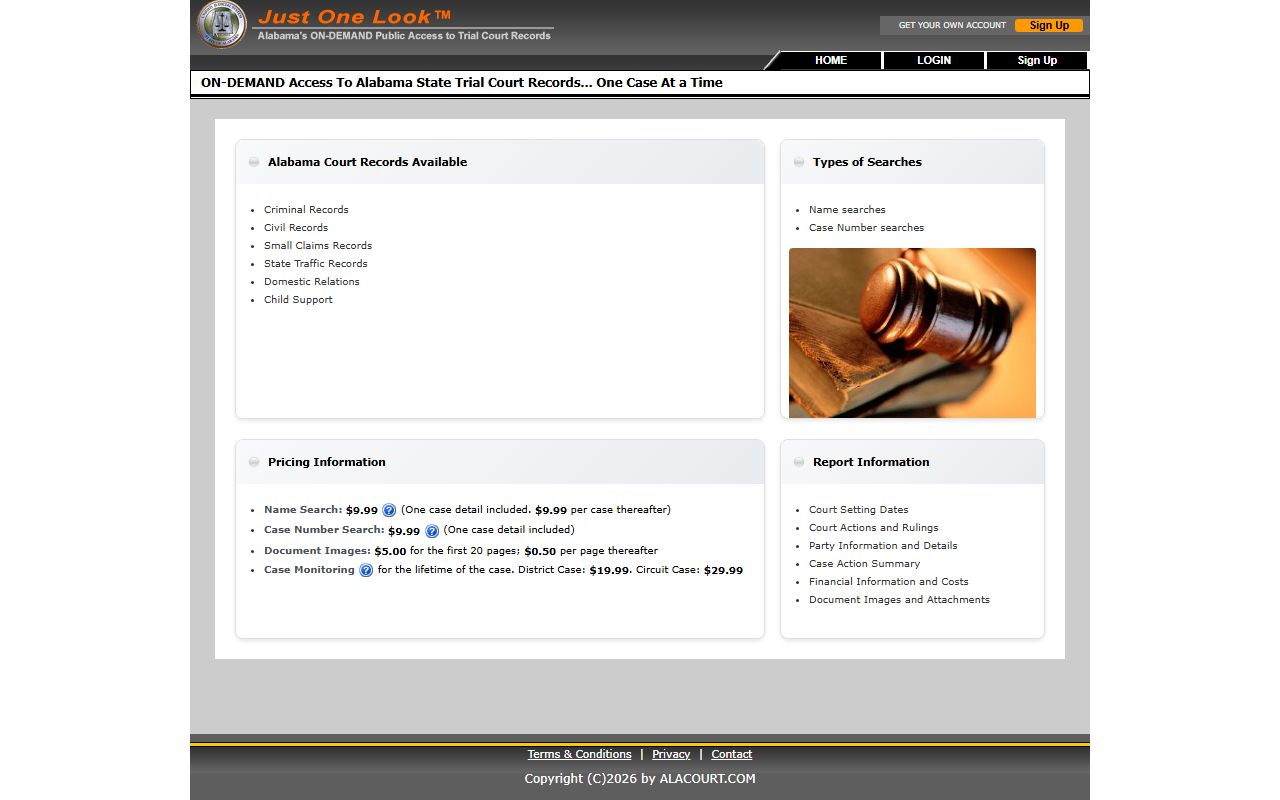
Use the portal for the court case, then use the clerk if a docket image, payment question, warrant issue, or older record requires direct office handling.
- Gather the defendant's full name, approximate arrest or booking date, and any case number from bond paperwork, citation paperwork, or attorney notices.
- Search Alacourt by defendant name or case number, then identify Autauga County or 19th Judicial Circuit results.
- Open the criminal case docket and compare the filed charge list to the jail booking charge.
- Check each charge for status, charge level, disposition, hearing dates, and any bond or payment entries shown by the court system.
For statewide criminal-history records, Alabama Law Enforcement Agency material is separate from the court docket. ALEA's expungement instructions say a certified Alabama criminal-history record is needed before filing an expungement request. A repository record can support official record-clearing work, but it does not replace the court docket or the clerk's certified court file.
How Charges Get Filed After an Arrest: Complaint, Information, and Indictment
A jail booking record starts when a person is received into custody at the Metro Jail. The court charge record starts or changes when legal paperwork reaches the court. In Autauga County, the court level depends on the charge. District Court commonly handles misdemeanors, traffic matters, and preliminary hearings, while Circuit Court is central for felony and higher-court criminal matters. The prosecutor can file or pursue charges that differ from the original booking label.
| Complaint | Information | Indictment | |
|---|---|---|---|
| Filed By | Officer or prosecutor, depending on the case path | Prosecutor | Grand jury |
| Common For | Initial criminal accusation, warrant support, misdemeanors, or lower-court starts | Prosecutor-filed charge in appropriate cases | Felony prosecution and serious criminal matters |
| Starts | Case filing or warrant process | Formal prosecution charge | Circuit-level felony charge after grand-jury action |
The Circuit Clerk source captured for this build lists criminal, traffic, juvenile, payments, and bookkeeping contacts.
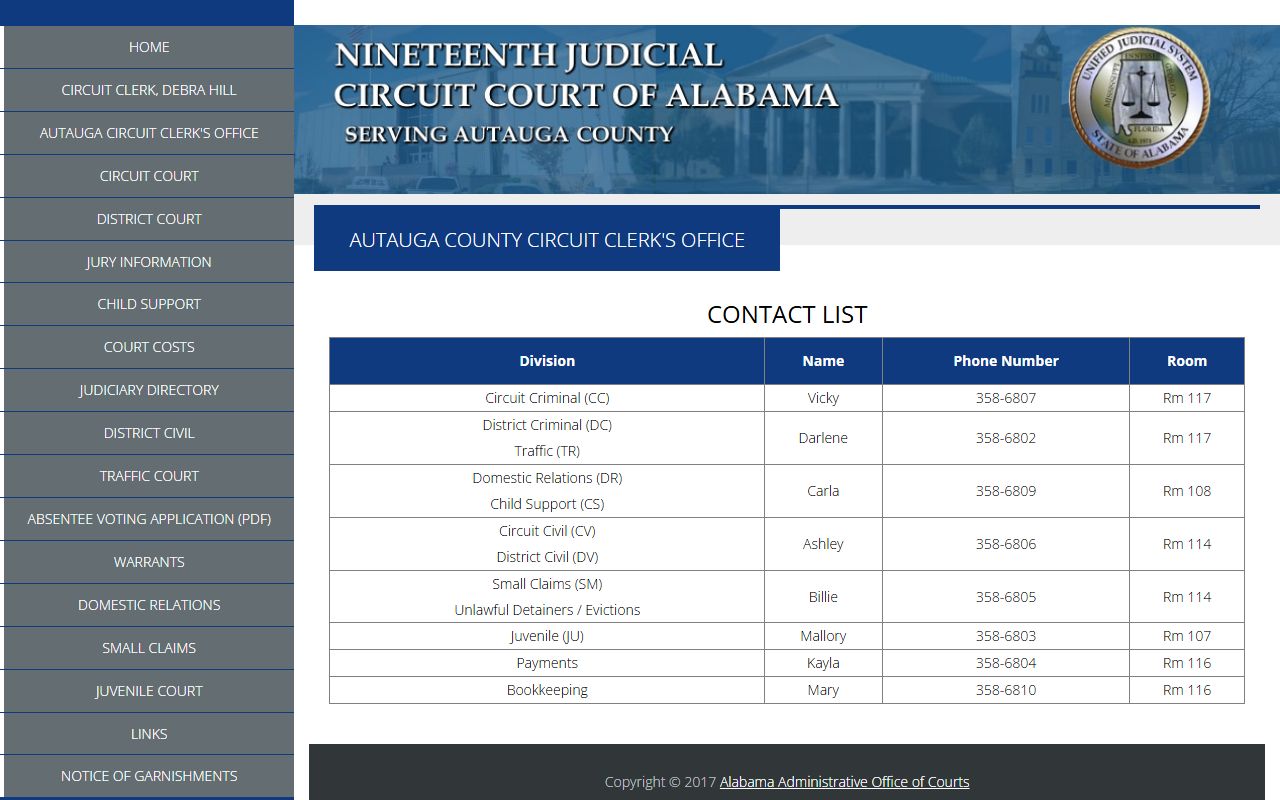
Those contacts matter because a court docket may show the case index while copies, payments, warrant questions, or division-specific questions still require the clerk's office.
Charge Status and What It Means
Charges can change after booking. A booking charge is an intake label. A filed charge is the formal court accusation. Prosecutor review, grand-jury action, plea negotiations, hearings, and dismissal orders can all change the status. That is why a jail roster screenshot should not be treated as the final court record.
| Status | What It Means |
|---|---|
| Pending | The charge is unresolved and still active in court. |
| Amended / Reduced | The charge language, code, or level changed, or a lesser charge replaced a more serious charge. |
| Dismissed | The charge ended without a conviction on that charge. |
| Nolle Prosequi | The prosecutor declined to continue prosecution of that charge. |
| Bound Over | A lower-court felony matter was sent forward for grand-jury or circuit process. |
Bond and Release After an Arrest
Bond information can appear in court or custody paperwork, but Autauga research points warrant and bond amount questions to the Circuit Clerk. The sheriff FAQ says that if a person knows they have a warrant, the best course is to turn themselves in and contact the Circuit Clerk's Office to find out the bond amount before surrendering. The Metro Jail at (334) 361-2600 is the local custody-status route, while the Circuit Clerk at (334) 358-6800 and the criminal division numbers are the court bond and warrant-route contacts.
| Bond Type | How It Works |
|---|---|
| Cash Bond | Money is posted directly through the court or jail-related process when allowed. |
| Surety Bond | A licensed bail bonding company posts the bond under Alabama's commercial bail system. |
| Property Bond | Property is pledged if the court allows that bond form. |
| PR / Own Recognizance | The court permits release based on the person's promise to appear. |
| No-Bond Hold | A court or another agency prevents ordinary release until further action. |
A bond amount does not always mean immediate release. Another county, state parole or corrections authority, federal agency, or ICE can place a detainer or hold. The court, attorney, or holding agency may be needed to clarify those situations.
Warrants That Lead to an Arrest
Autauga County's sheriff FAQ makes warrant handling unusually specific. A person who thinks they have an arrest warrant must go to the Sheriff's Office at 162 W. 4th Street in Prattville with valid ID. The sheriff does not verify warrants by phone. If a person already knows they have a warrant, the FAQ recommends turning themselves in and contacting the Circuit Clerk first to learn the bond amount if one is available.
For someone trying to obtain a warrant, the FAQ says a police report must be filed first. The complainant then takes a copy of the report to the Circuit Clerk's Office to request issuance. The clerk may deny issuance, and retaliation warrants will not be issued. A warrant arrest can create a Metro Jail booking, but the issuing court and clerk remain important for bond, failure-to-appear, and case-status questions. Municipal matters, such as Millbrook traffic, misdemeanor, or ordinance cases, may involve a city court even when the person is booked through the county jail after arrest.
Charges vs. Convictions
An arrest, booking charge, or filed charge is not a conviction. It is an accusation or active case step unless and until a guilty plea, verdict, or other conviction disposition is entered. Court users should read the charge status and disposition, not just the charge name.
| Charge | Conviction | |
|---|---|---|
| Stage | Accusation or filed count | Verdict, guilty plea, or other adjudication establishing guilt |
| Burden of Proof | Probable cause or charging standard | Beyond a reasonable doubt for conviction |
| Public Record | Often public unless restricted, sealed, expunged, or juvenile | Often public unless restricted, sealed, expunged, or otherwise protected |
Sealed vs. Expunged Arrest Records
Alabama Code Section 15-27 and ALEA's expungement page provide the official route for eligible criminal-record clearing. ALEA says a court grants expungements and that a certified criminal-history record should be obtained before filing. The jail cannot simply erase a court case because someone asks, and ALEA does not grant the expungement by itself.
| Sealed | Expunged | |
|---|---|---|
| Visibility | Removed or hidden from ordinary public access when a court order applies | Removed from public access under an eligible Alabama expungement order |
| Law Enforcement | Access may remain for limited official purposes | Official access can remain limited by Alabama law and court order terms |
| Eligibility | Depends on the record type and court order | Depends on Alabama Code Section 15-27 eligibility and court approval |
Background Check Considerations
Casual court lookup is different from a regulated background check. Alacourt, the Circuit Clerk, the sheriff's roster, ALEA criminal-history records, ADOC, BOP, ICE, and VINELink each answer different questions. Use official records from the originating agency when accuracy matters, especially when a charge has been dismissed, amended, expunged, or transferred to another custody system.
Important: This site is not a consumer reporting agency and must not be used for FCRA-covered decisions.
Restricted Court Records After an Arrest in Autauga County
Not every record is available through a public search. Alabama Code Section 12-15-133 restricts juvenile court records. Youthful-offender records can also be excluded from public inmate search systems, and ADOC states that Youthful Offender Act inmates are not included in its inmate search and population totals. Sealed or expunged records may disappear from public portals after the proper court process.
Ongoing investigations, restricted warrants, records involving protected victims, and records requiring clerk review may need in-person or official-agency handling. If the person has been sentenced to state prison, use the Alabama Department of Corrections inmate search. If the case is federal, use BOP inmate locator after designation. For custody notifications, Alabama VINELink is a notification tool, not a complete court docket.